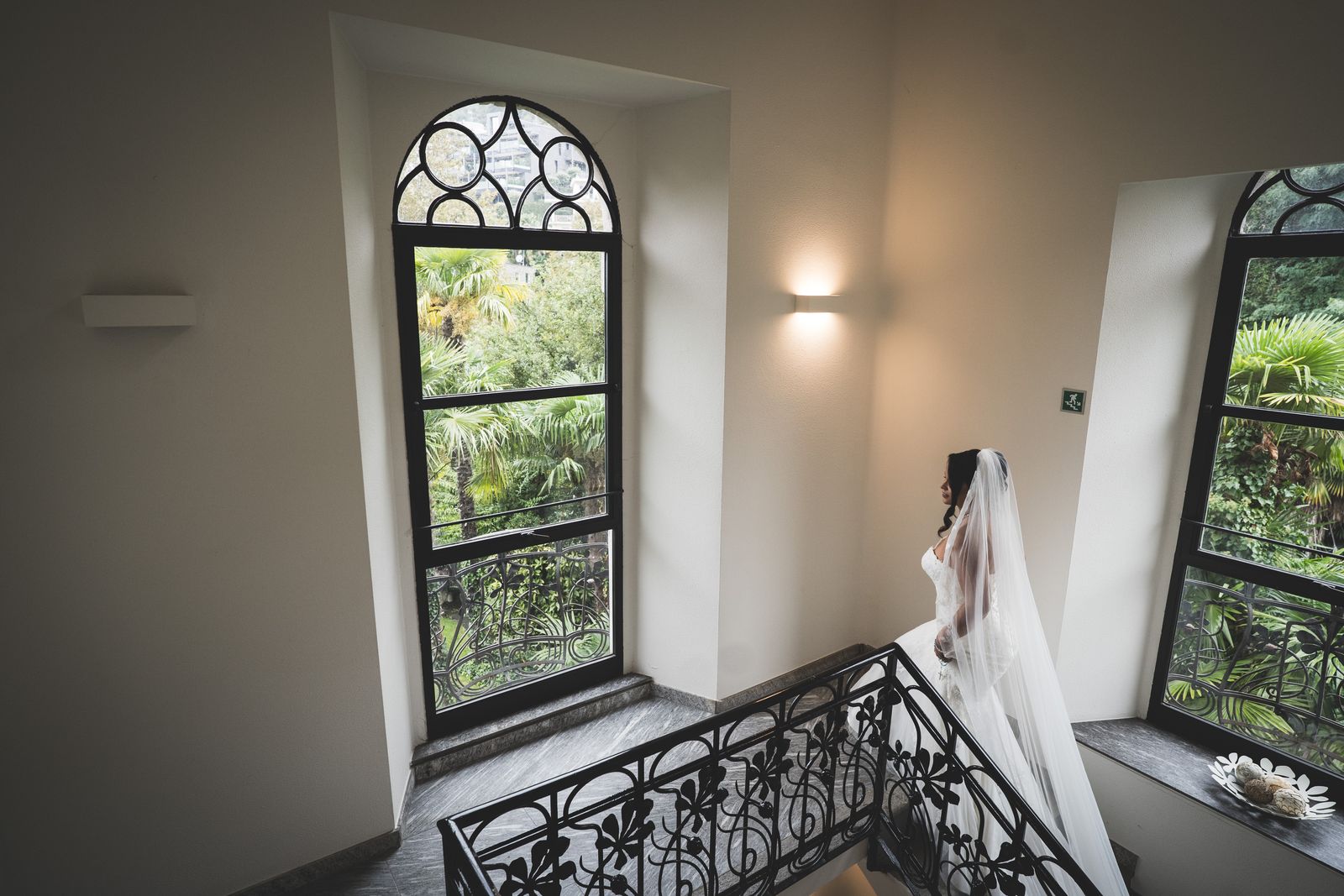
Getting married in Cernobbio
Cernobbio is the first village on the western shore of Lake Como once you leave the city behind, where the water of the Como branch is still narrow and the hills come down steeply to the road. Most couples know the name because of its villas, and that reputation is earned: a grand hotel, a former family villa that is now a congress centre, an Art Nouveau house owned by the town and a private estate with an Italian garden all sit within the same stretch of shore. What is less known is that it is also a real village with a real town hall, a working waterfront and old churches on the slope behind.
The place is old. The Roman road that became Via Regina ran through it, and the first certain document of the Benedictine monastery of the Assunta, one of the possible origins of the village’s name, dates from 930. The village was destroyed in 1432 on the order of Filippo Maria Visconti, and by 1630 the plague had reduced it to fewer than two hundred people. Silk weaving gave it a second life in the later nineteenth century, and the textile family of Bernasconi left the town its most unusual house. In 2005 Cernobbio was given the honorary title of city by presidential decree.
The villas are what a bride will notice first. Villa d’Este was designed in 1568 by Pellegrino Tibaldi as a summer residence for Cardinal Tolomeo Gallio, and in 1815 Caroline of Brunswick, then Princess of Wales, bought it and renamed it Nuova Villa d’Este. It became a hotel in 1873, and its villa and ten-hectare park were declared a national monument in 1913. Villa Erba, on the shore beside it, was built by Luigi Erba and is where the film director Luchino Visconti spent many summers; since 1986 it has belonged to a public consortium and serves as an exhibition and congress centre. A little further on lies Villa Pizzo, begun in 1435 by the Como merchant Giovanni Muggiasca, with a terraced park that runs down to the lake.
For a bride this means a wedding that moves between very different scales: a small municipal room for the civil ceremony, a large historic property for the dinner, and a stone waterfront where the light changes by the hour. Elena’s job is to make one look that works across all three, and to make the morning calm enough that you arrive at the first of them rested.
Wedding makeup artist in Cernobbio: at a glance
- Artist
- Elena Potapenko, bridal hair and makeup, 18+ years of experience
- Based in
- Veneto, Italy; travels to Cernobbio for weddings
- Specialty
- Bridal hair and makeup by one artist, with a trial before the day, plus hair and makeup for the mother of the bride and the bridal party
- Languages
- English, Italian, Ukrainian and Russian
- Booking
- Check whether your date is free
Where weddings happen in Cernobbio
Cernobbio offers two municipal rooms for the civil ceremony, a hotel and several villas for the celebration, and parish churches for a religious service. Each one asks something different of the hair and the makeup.
The Comune: Sala Stemmi and the Stato Civile office
The Comune di Cernobbio lists two places for civil ceremonies, the Sala Stemmi in the municipal building and Villa Bernasconi. Requests are made through the Comune’s online portal, the Sportello Telematico, and handled by the Ufficio di Stato Civile, which also takes the paperwork and the publication of the marriage. The Sala Stemmi is the formal, municipal option. It is indoors, so it is safe in any weather, and the registry will tell you which room your slot is in and how many people it holds.
Villa Bernasconi
The Liberty villa with a staircase tower was completed in 1906 by the Milanese architect Alfredo Campanini for the silk manufacturer Davide Bernasconi. The Comune bought it in 1989, began restoring it in 1995, and it now houses a museum of Liberty style and the Bernasconi family that opened in November 2017. The council decided in 2014 to open it to civil weddings from 2015, and the Comune lists catering for weddings as a service of its own. Outside, the brick and ceramic-tile friezes and the cement decorations with silkworm motifs are worth a photograph.
Villa d’Este and the grand-hotel wedding
Villa d’Este has been a hotel since 1873 and is one of the best-known on the lake, with a park of ten hectares and a pool that floats on the water, opened in 1966. A wedding here is arranged with the hotel itself, which sets what can be held where and at what hours. The legal civil rite is a separate matter: in Cernobbio the Comune names its own rooms for it. Ask the hotel’s events team what it offers in the grounds, ask the Stato Civile office what is needed for the legal part, and tell Elena the schedule you end up with.
Villa Erba, with its park and private dock
Villa Erba is run as an exhibition and congress centre, and its own website also presents the historic villa and the park for private events and weddings. The Luchino Visconti rooms can be visited by appointment, and the property has a private dock on the lake. On days when the centre has a large event, the whole shore road is busier, so ask the venue for its calendar before you fix the timeline.
Villa Pizzo and the private estates
Villa Pizzo, between Cernobbio and Moltrasio, has been owned by the Volpi Bassani family since 1871 and has a garden with Baroque fountains, an avenue of cypresses and a fountain dedicated to Alessandro Volta. It opens by appointment and for events. Private estates like this set their own hours, their own access for suppliers and their own rules about where the bride may get ready, so that is the first question to ask them.
The village churches
For a Catholic service the options include the church of San Vincenzo, which has twelfth-century origins and was rebuilt several times from the eighteenth century, and the parish church of Piazza Santo Stefano, consecrated in 1785 in the raised hamlet above the centre. Higher up are San Michele Arcangelo in Rovenna, from the sixteenth century, and the sanctuary of the Beata Vergine del Bisbino on Monte Bisbino, from the seventeenth. Services follow the parish’s timetable, so the morning is counted back from the time the church gives you.
The riva and the lakefront
The village grew along the shore, in the area called la riva, where the lake boats have called since an agreement with the navigation company in 1887. The waterfront, the landing stage and the small streets behind it are where most couples take their portraits. The quiet hours are early morning and the last light of the day, when the hills behind the village turn the shade early.
These are places where couples marry in and around Cernobbio, not a list of Elena’s past jobs. If your ceremony is at another venue on the shore, the plan works the same way: tell her the venue and the time, and the morning is counted back from there.