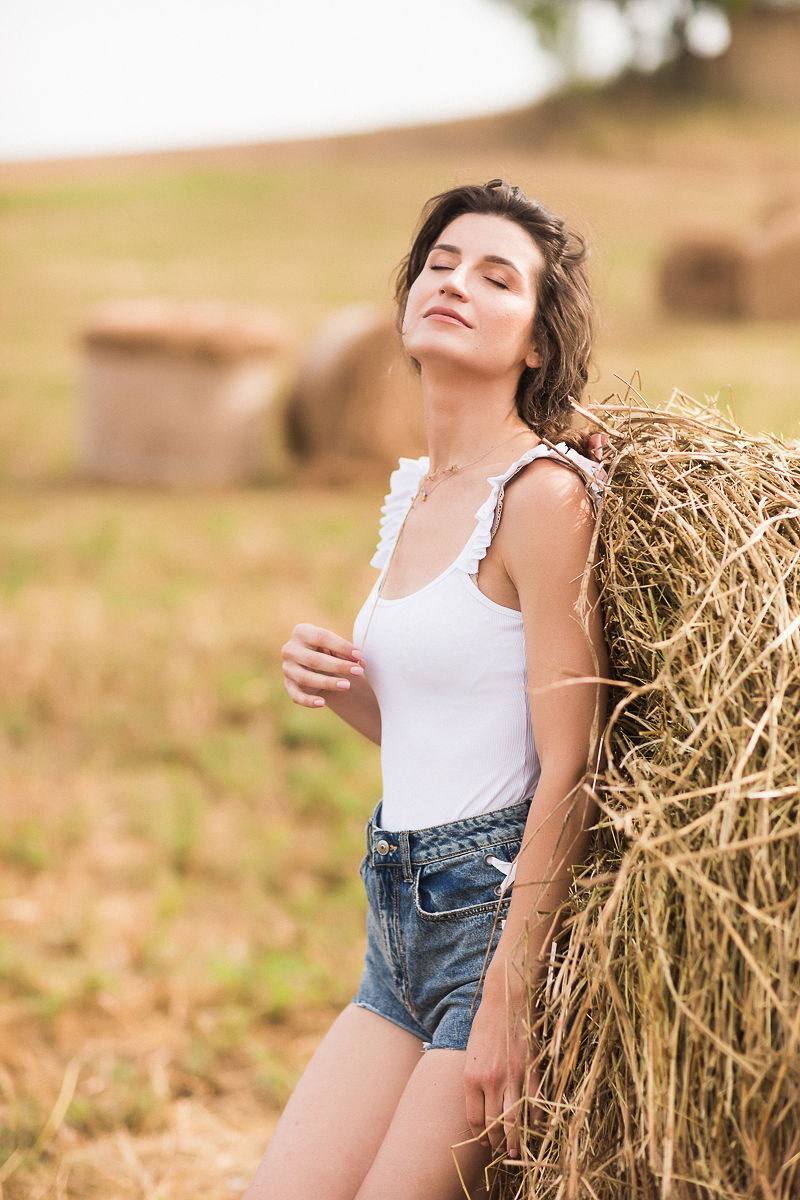
A maternity shoot has one rule that sets it apart from every other kind of session: the pictures have to look like you, now. Not a smoothed version of you. That is the whole reason heavy makeup works badly here — it erases exactly the thing that will make these photographs recognisable in ten years.
What actually changes, and why it matters for makeup
Skin behaves differently in pregnancy, and not always in the same direction. Often it becomes more reactive: areas that flush more easily, a new dislike of fragrance that was never a problem before. Just as often it goes the other way — skin that is unusually luminous and needs less product than it used to.
Two practical consequences. Nothing is decided on the basis of what worked a year ago. And where pigmentation has appeared during pregnancy, the work is to even it out with light rather than bury it under layers, because on camera a heavily covered patch reads more clearly than the thing it was meant to hide.
"Is makeup safe in pregnancy?"
This is the question I am asked most, and the honest answer is that it is not mine to give. I am not a doctor and I do not advise on ingredients during pregnancy — if you have a question about a specific substance, that conversation belongs with your obstetrician or a dermatologist.
What I can do is practical, and it usually settles the matter. You can bring your own products and I will work with those. I can stay on fragrance-free formulas if you prefer. We can test a small area the day before if you have had new reactions. And if your doctor has told you to avoid something, tell me beforehand and it stays out of the kit.
The look that actually holds up
Most maternity sessions are shot in natural light, often backlit, often outdoors or beside a window. That light is unforgiving in a particular way: it shows texture and flattens colour. Which leads to the choices that work almost every time.
- A light base, built in zones. Coverage where it is needed, bare skin where it already looks well. Backlit, an evenly applied base turns into a pale mask.
- Natural luminosity, not visible highlighter. Fine glitter in a high-resolution file reads as grainy skin, not as light.
- Eyes defined but open. Full lashes and a soft blend hold better than solid black, which closes the eye in close frames.
- Lips in your own shade, slightly deeper. In couple frames and hands-on-bump shots the face is often secondary; a strong lip pulls attention away from the picture.
- Hair with movement, not set hair. The poses are soft, and a rigid style fights the image.
Alone, with your partner, with older children
This sounds like scheduling and is in fact a makeup decision. Shooting alone, your face is the subject and carries more definition. Shooting as a couple, the best frames are usually close — cheek against cheek — and a foundation that transfers becomes a real problem, so the formula has to be one that stays put on contact.
If older children are in the session, assuming they will touch your face and hair is planning, not pessimism. There I build higher hold into the base and gladly give up a heavily pigmented lip, which after the first hug is everywhere except where it belongs.
When to book it
The window that usually works best is between about twenty-eight and thirty-four weeks: the bump reads clearly on camera and moving around is generally still comfortable. Later is possible, but plan for more frequent breaks.
Two things matter more than any product. Have hair and makeup done as close to the start of the shoot as possible, not three hours ahead. And keep the room cool — heat is the first enemy of wear, always, and it is tolerated less well in pregnancy. The habit of counting backwards from the moment that matters rather than from the start time is the same one described in the destination beauty timeline.
What to bring, and what to skip
Bring the products you use and know you tolerate, a photograph of a look you liked on yourself rather than on a model, and the first outfit if you have it — fabric colour changes the choices just as it does for any event.
Three things to skip. Fake tan applied the day before, which turns orange on camera and can take unevenly where skin is stretched. Any new treatment in the week of the shoot: this is not the time to discover how your skin responds. And a look copied wholesale from someone else's photograph — useful as a mood reference, misleading as an instruction, because what makes that picture good is usually the light rather than the product.
If the session is part of a larger project with a photographer, the questions worth asking before booking are much the same as in choosing a photoshoot makeup artist.