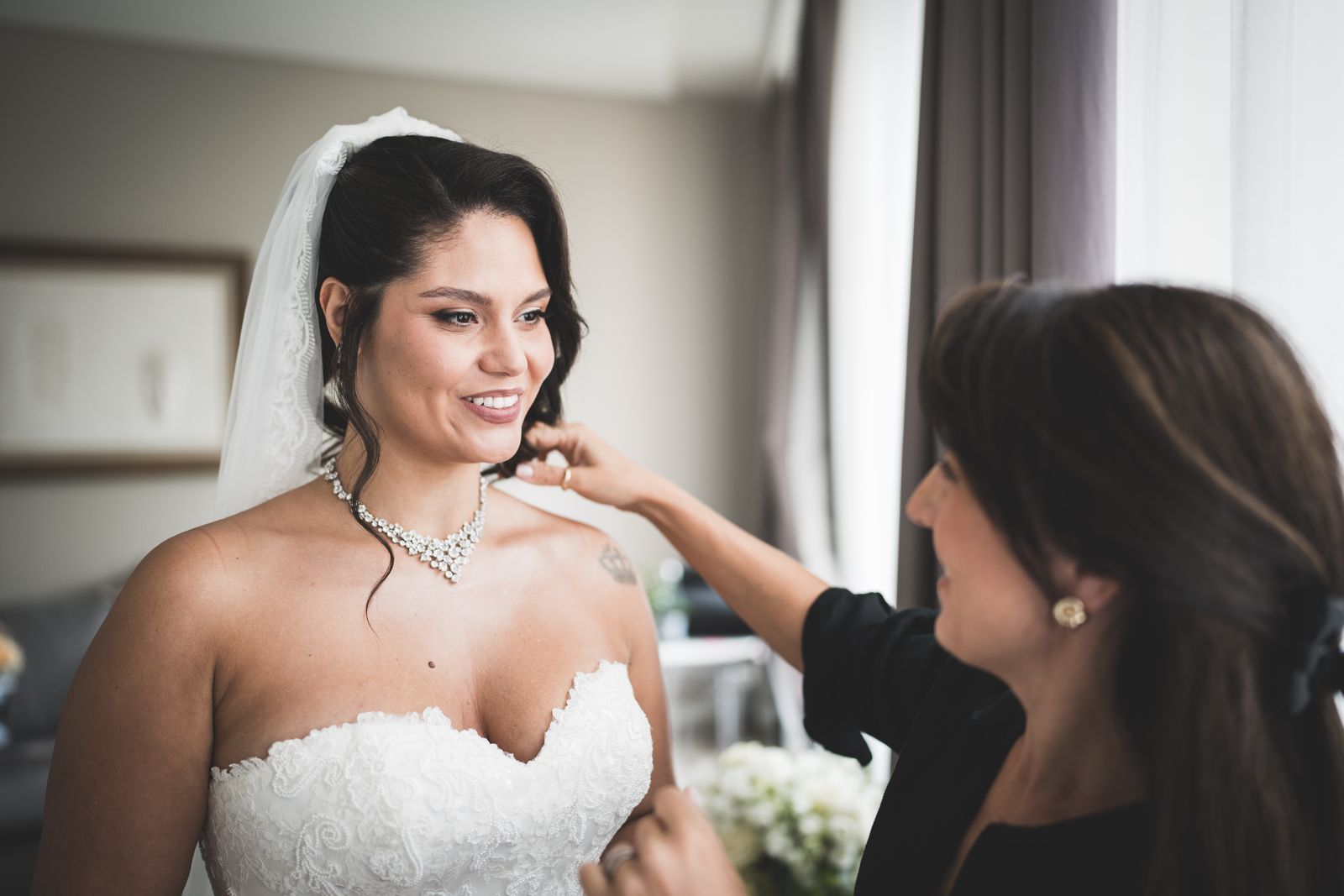
Three hours. That is the honest answer for the bride alone, from the moment she sits down with a clean face to the moment the veil is on and she can walk out of the door. Not three hours of makeup: three hours of everything that has to happen to her, in an order that cannot be shuffled. Below is where that time goes, why each part takes as long as it does, and how the same three hours behave differently at Lake Garda and in Venice.
Mothers and bridesmaids come on top of the three hours. They are planned before the bride, never after her: the bride is finished last, so her makeup is at its freshest when the doors open.
Where the three hours go
- Skin preparation, about 15 minutes. Cleansing, hydration, eye patches, lip balm, and a few minutes for the products to settle before anything else goes on. Skipping this is the most common reason a base separates by the afternoon.
- Makeup, about 55 minutes. Base, concealing, brows, eyes, lashes, contour and blush, built in thin layers and set properly. Lashes alone need a few minutes to bond before the eyes can be finished.
- Hair, about 55 minutes. The structure chosen at the trial: preparation, curling or smoothing, the base the veil will hang from, pinning and setting. Very long or very thick hair, extensions or a braided updo can need more, and the trial is where we find out.
- Décolleté, neck and shoulders, about 10 minutes. More on this below.
- The dress, about 20 minutes. With help, and usually with the photographer in the room.
- Veil, final check and touch-up, about 10 minutes.
- Reserve, about 15 minutes. Not optional. It absorbs the interruptions described further down.
Makeup and hair are the two heaviest blocks, and when one artist does both they happen one after the other, not at the same time. That is the trade: a single look built by one pair of hands, in exchange for a schedule that has to start on time.
Why the décolleté is part of the makeup
With an open neckline, a strapless bodice or a low back, the face is not the only skin in the photographs. If the face is evened out and the neck, chest and shoulders are not, the camera shows the join: a face a shade lighter or warmer than the body, most visible in flash and in outdoor portraits. So the tone is carried down. Redness on the chest and at the base of the neck is evened, the shade is matched to the face, a little light goes where the collarbones catch it, and nothing with shimmer goes where the fabric will touch.
This is done before the dress and given a few minutes to set. Anything that could transfer is finished and fixed while the bodice is still on its hanger, so the first contact between skin and fabric is clean. Once the dress is on, the edges of the neckline get a last check.
Getting into the dress
Twenty minutes is realistic for most gowns with someone helping. A laced corset or a row of covered buttons down the back takes longer, and it is worth timing it once at a fitting. Wear a button-front shirt or a robe while hair and makeup are done, so nothing has to come off over your head. Step into the dress rather than lowering it from above, and if anything does have to pass close to the face, hold a thin scarf over it.
Photographers usually want this moment. Decide in advance who helps you into the dress, so the room is not full of people waiting for instructions.
Attaching the veil
The veil goes on last, after the dress, because a veil pinned earlier gets caught, crushed or pulled while the dress goes on. Where it sits is not decided on the day. At the trial we choose the height (on the crown, at the base of a chignon, under it) and the hair is built around that point, so the comb is anchored into the structure rather than into loose hair. Then you turn your head, sit, stand up and walk a few steps, because a veil that only holds while you stand still is not attached yet.
If the day involves a boat or a windy terrace, we may agree that the veil goes on at the venue instead of in the room. That decision belongs in the schedule, with its own five minutes, not improvised on a jetty. The guide to wedding hairstyles in Italy covers which styles carry a veil best.
The interruptions nobody schedules
Organisational questions are what make a calm morning run late. The florist arrives with the buttonholes and asks where they go. The planner calls about the car. The photographer needs the rings, the shoes and the invitation for the detail shots. Someone from the hotel asks about the cake table. Each takes two or three minutes, and each one pulls the bride out of the chair and out of the mood.
Three things help more than any amount of speed:
- Name one person (the maid of honour, a sister, the planner) who answers every question that is not about your face or your hair.
- Hand your phone to that person when the makeup starts.
- Put the rings, shoes, perfume and anything for the detail shots into one box the evening before, and give it to the photographer when they arrive.
The fifteen-minute reserve is for whatever still gets through.
Lake Garda: heat before lunch, wind after it
On Garda the three hours stay three hours, but where they sit in the day matters. By late morning in summer the southern shore is hot, so I set up in a shaded corner rather than on the balcony and build thin, well-set layers for skin that will be warm all day. Around one in the afternoon the Ora comes up the lake from the south, and on the eastern shore and north of Torri del Benaco it is strong enough to lift a veil. That is why the hair structure and the veil anchor are designed at the trial for a windy terrace, and why the last ten minutes are never the ones that get cut.
The road is the other factor. The Gardesana is one lane each way, and a short transfer can take an hour on a summer Saturday, so the schedule is counted back from the moment the car must leave, with the road time added honestly. In Sirmione, cars stop at the castle gate and the last stretch to Palazzo Callas is on foot or by the town shuttle: one more reason the veil is fixed to hold while you walk. More on the lake in bridal hair and makeup at Lake Garda.
Venice: counted back from the boat
In Venice every schedule starts from a single time: when the boat has to leave your hotel. The Comune sets the hall and the hour of a civil ceremony, the hall and the hotel set the crossing, and the three hours end when you step into the water taxi, not when you arrive.
As an example: a ceremony at 11:00, a twenty-minute crossing and ten minutes to walk in and settle means the boat leaves at 10:25, the bride is ready at 10:15 and sits down no later than 7:15, with the bridal party before her. Humidity from the canals is constant even on a cool day, so the base is set for long wear and the hair is built without relying on fresh blow-dry volume. The veil often goes on after the crossing, at the venue, and we agree where in advance. More in bridal hair and makeup for a Venice wedding.
How to plan your own morning
- Start from the time you have to leave, not from the ceremony time.
- Take three hours off that: this is when you sit down in the chair.
- Before that, add the time for everyone else having hair or makeup, agreed with your artist per person, because makeup only and makeup with hair are not the same block.
- Choose a getting-ready room with a window for daylight, a table, a free socket and a chair at a normal height.
- Eat a light breakfast, and keep a drink with a straw nearby for after the makeup.
- Do the trial. It is where the timing is measured on your own hair and skin; read what happens at a bridal makeup trial.
Frequently asked questions
How long do bridal hair and makeup take on the wedding day?
About three hours for the bride alone: skin preparation, makeup, hair, the décolleté, getting into the dress, the veil and a short reserve. Mothers and bridesmaids are scheduled before the bride, not inside her three hours.
Can bridal hair and makeup be done in two hours?
The makeup and the hairstyle can be simplified, but cutting the reserve, the décolleté or the veil is what makes a morning run late. If the morning is genuinely short, simplify the hairstyle at the trial rather than rushing on the day.
When should the bride put on her wedding dress?
After hair and makeup are finished and the décolleté has set, usually about half an hour before leaving. The veil goes on after the dress, never before it.
Who should deal with suppliers while the bride is getting ready?
One named person: the maid of honour, a relative or the planner. They hold the bride's phone and the box of rings and details for the photographer, so the bride is not pulled out of the chair.