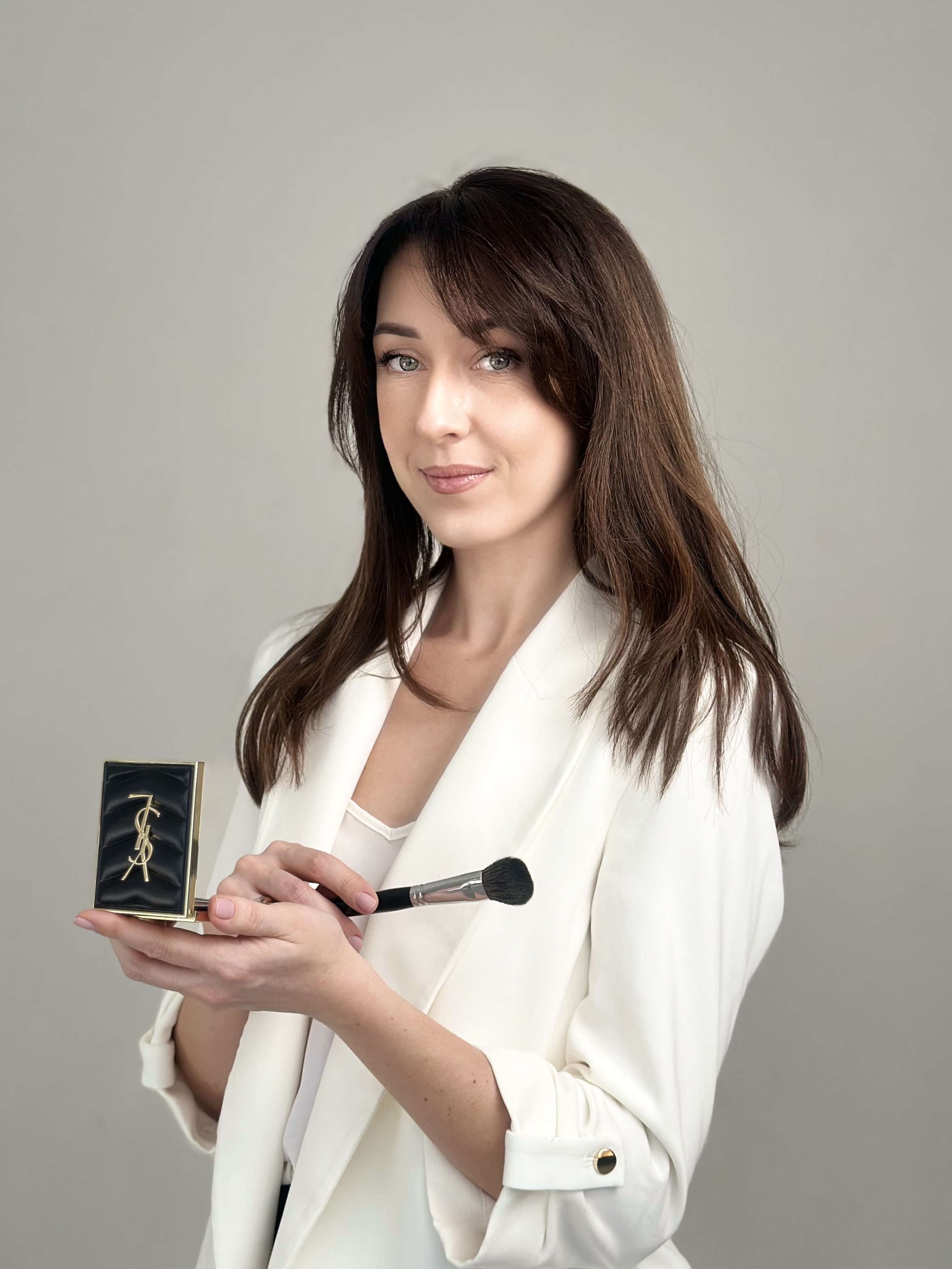
This is one of the questions I am asked most often by brides planning from abroad, and it is almost always asked the wrong way round. It comes in as a cost question — what does it cost to fly my makeup artist to Italy — when the cost is the easiest part to find out. The harder questions are what actually changes when an artist works outside the conditions she knows, and what happens on the morning if something goes wrong.
I am obviously not a neutral party here: I am the local artist. So let me start with the case for the other side, because it is a real one.
The genuine case for bringing your own
Someone who has done your face ten times knows things no brief can transmit: which side you part your hair on when you are nervous, that your left eye sits slightly lower, which foundation oxidises on you by the afternoon, what you actually look like when you are happy rather than posing. That is real knowledge and it takes years to build.
And on a day when almost everything is unfamiliar — the venue, the language, the caterer, the weather — having one person in the room who is not a stranger has a value that does not show up on any spreadsheet. Brides who bring their artist are usually not buying a technique. They are buying the absence of one more unknown.
The flight is the cheapest line on the invoice
What surprises people is the shape of the cost rather than the size of it. The airfare is usually the smallest component. Around it sit:
- Travel days. An artist flying in for a Saturday wedding realistically arrives Thursday and leaves Sunday or Monday. Those are days she cannot work at home, and they are billed.
- Accommodation. Three nights minimum, in wedding season, near a venue that is often an hour from the nearest town — where the affordable rooms went a year ago.
- A second person. If she does makeup and someone else does hair, everything above doubles.
- Ground transfer. Villa weddings are rarely near a station. Someone is driving, or a car is being hired for three days.
- The trial. If it happens at home before the trip, you are paying twice for the same face — once in your city, once in Italy — or going into the wedding day with no trial in the conditions that matter.
None of that makes it wrong. It just means the honest comparison is not "her fee plus a flight" versus a local artist's fee. Work out the real total first, then decide — it is a different decision than most people think they are making.
The kit does not travel the way people assume
This is the part that catches even experienced artists out. A professional kit is mostly liquid, and hand luggage limits it to almost nothing usable. Which means the working kit goes in the hold, and the hold is where things happen: bags arriving a day late at the height of the summer peak, or arriving broken, or arriving on a different island.
Airbrush equipment is its own problem. Compressors are usually fine but frequently questioned, and pressurised canisters are refused outright by most carriers. If your look depends on airbrush and the compressor does not clear security, there is no plan B in the departure hall.
And if something runs out or shatters, restocking is not straightforward. The shade ranges on an Italian shelf are not the shade ranges on a British or American one; the same brand carries different products here, and the very pale and the very deep ends are the hardest to replace quickly. I have lent out foundation to visiting artists more than once, and each time it was because a specific shade simply did not exist within an hour's drive.
The question nobody asks: what is the backup?
This is the one I would push hardest on, and it is not about money at all.
If I wake up on a Saturday unable to work — illness, a car that will not start, a road closed by a storm off the lake — I make three phone calls and someone I trust is at the villa within the hour. That network is the most valuable thing an established local artist has, and it is invisible until the day you need it. It took me years to build and it does not travel.
An artist flying in has no such network. If her flight is cancelled the evening before, or she is unwell on the morning, or her luggage does not arrive, the bride is sourcing a professional in a foreign country with hours to go. So ask the question out loud, well in advance, and ask it of whoever you book, me included: what happens if you cannot get here? An answer worth hearing has names in it.
Your face in Italian conditions is not your face at home
An artist who works in London, Munich or the northern United States has never had to test her formulas at thirty-four degrees with high humidity beside a lake. She has not seen what the reflected light off Venetian water does to a base that photographs beautifully indoors, or what happens across the ninety seconds between an eighteen-degree stone church and the full sun on the steps outside.
That is not a comment on her skill. It is untested ground, on the one day there is no room to test anything. My own primer and foundation choices in August are not my choices in October, and I only know that because I have been wrong about it here before. If you do bring your own artist, the single most useful thing you can do is send her honest information early: the month, the hour of the ceremony, whether the ceremony is indoors, and photographs of the venue in daylight. More on this in the guide to wedding makeup in Italian heat.
The practical details on the Italian side
Two small things that are easy to miss. Some Italian venues ask suppliers for proof of professional liability insurance before they will let them work on site — a local professional has a policy the venue recognises, and a visitor may not. And if you need a proper invoice for the beauty line of your wedding, an Italian artist issues one with an Italian VAT number, which matters if a planner is consolidating your supplier payments.
Neither is a reason on its own. They are just the kind of thing that surfaces three weeks before the wedding if nobody raised them earlier.
When bringing your own genuinely makes sense
- You have a long relationship with an artist and a look built over years that you do not want reinterpreted.
- Sensitive or reactive skin, an allergy history, or a condition where the products that work for you took a long time to find.
- She is a close friend or family member who is attending anyway, and the travel cost exists regardless.
- A small elopement where the whole day is two people and a photographer, and the logistics are simple.
- Your budget has room and you would rather spend it here than on another line — which is a perfectly good reason, as long as it is a choice and not an assumption.
When a local artist is the better answer
- A wedding party of more than two or three faces, where travelling the whole team stops making sense quickly.
- A summer wedding outdoors, where local experience of the conditions is worth more than familiarity with your face.
- Any situation where you want a real backup plan rather than a hopeful one.
- A venue that is genuinely remote, where an artist who does not know the roads adds risk to a tight morning.
The middle path most of my brides end up on
In practice, the brides who are happiest with the result did not choose between loyalty and logistics — they closed the knowledge gap instead. That means a video call early rather than an email exchange, a proper trial booked around a trip you are already making, and a look brief built from photographs of yourself on days you liked how you looked, not from photographs of models. That combination gets a local artist to roughly the same place your own artist would start from. I have written about how to run that process from another country in planning bridal makeup from abroad.
There is also a split that works well and is under-used: your own artist for you, and a local artist for the rest of the party. One person travels instead of three, the mothers and bridesmaids are covered by someone who works these conditions every weekend, and nobody spends the morning rushing.
I work across Verona, Venice, Milan, Lake Garda, Lake Como, Lake Maggiore and Tuscany, and I am glad to be a second opinion even if you end up bringing someone with you.